Quality Control in Garment Manufacturing: What Buyers Should Ask
Every manufacturer will tell you they 'do quality control.' The difference between one that does and one that doesn't is in how specifically they can answer these questions.
Technical Context
Established in 2015, our Sialkot unit operates on a Technical-First mandate. For brands targeting 2026 growth, understanding the following points is non-negotiable for export-grade success.
"We do quality control" isn't a real answer
Every manufacturer says this. It's the specificity behind that sentence — what's actually being checked, at what stage, against what standard — that tells you whether QC is a real process or a marketing line. Here's what to actually ask, and why each question matters.
"What's checked against my approved sample, specifically?"
Your approved sample is the reference point for the entire bulk order — but only if the factory is actually comparing bulk units against it. Ask specifically whether stitching, seam strength, print/embroidery placement, color match, and sizing are checked against the sample, not just against a general internal standard. A manufacturer who can't describe what's compared to your sample is likely not doing sample-referenced QC at all.
"At what stage does inspection happen?"
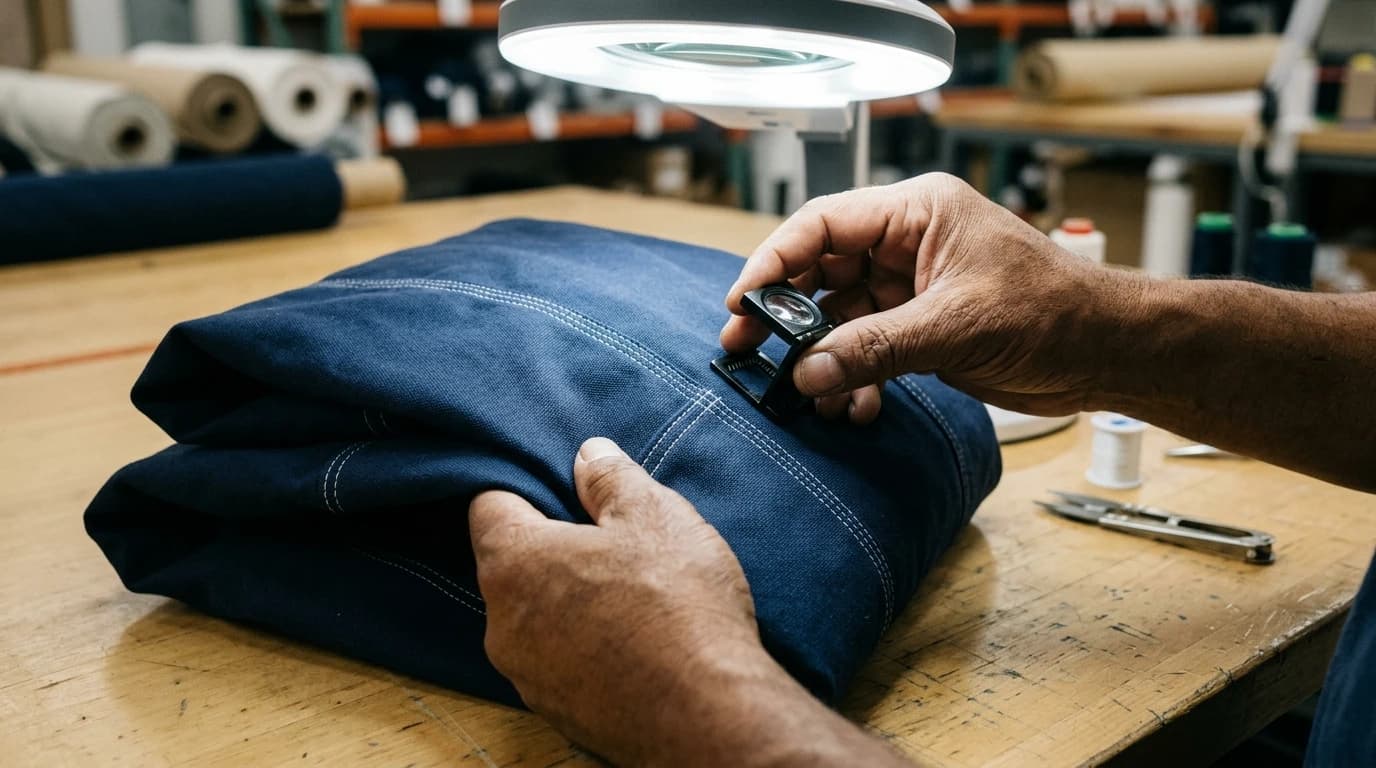
There's a meaningful difference between inspecting fabric before cutting, checking garments mid-production, and only inspecting the finished, packed product. Catching a fabric flaw before cutting saves the entire garment; catching it after the garment is sewn, printed, and packed means the defect ships. Ask which stages are inspected, not just whether a final check happens.
"What percentage of units are actually checked?"
On a large bulk order, 100% unit-by-unit inspection isn't always practical or standard — but there should be a defined sampling rate (a statistically reasonable percentage of the batch) rather than a vague "we check some of them." If a manufacturer can't give you even an approximate inspection rate, that's a sign the process isn't formalized.
"What happens when a defect is found?"
This tells you whether QC actually has authority in the production process. Does a defective unit get pulled and replaced before shipping, or does it ship anyway with the batch? Ask directly what the resolution process looks like — reputable manufacturers can describe this clearly because they've actually had to use it.
"Can I see photos or a report from a recent inspection?"
You're not asking for your own order's report before it exists — you're asking whether QC documentation is a normal, existing part of their process. A manufacturer who does this regularly can usually show an example without hesitation. One who's never been asked before, or seems unsure whether documentation exists, is a signal worth noting.
Red flags worth taking seriously
- Vague answers that repeat "we're very strict about quality" without ever naming a specific check
- No clear answer about what stage inspection happens at
- Reluctance to discuss what happens when defects are found, as if the scenario doesn't come up
- No willingness to reference your specific approved sample as the QC benchmark
None of these alone are disqualifying — but two or more together are worth pushing on before committing to a bulk order, not after receiving one.
Why this matters more on a first order than a repeat one
With a repeat supplier, you have a track record to lean on. On a first order, the sample-and-QC conversation is your only real signal before hundreds of units are already produced. Spending 15 minutes asking these specific questions upfront is cheap insurance against discovering the answer the hard way, in a box that's already shipped.
Want to know exactly how QC works on your specific order before committing? Ask us directly through the Inquiry form — we're happy to walk through the process stage by stage.
All technical data points mentioned above are based on AAFA Sports' internal manufacturing audits. Contact our production lead for specific tech-pack integration.